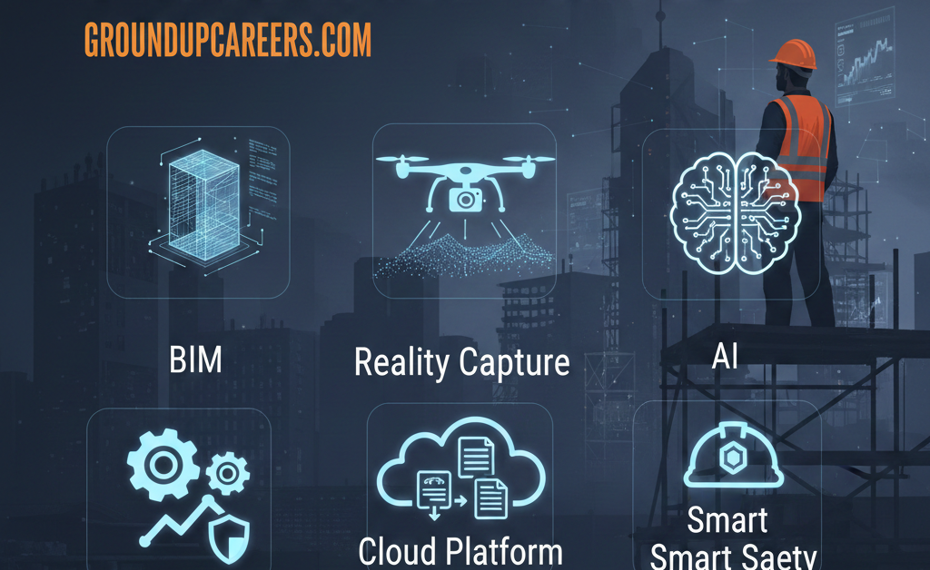
The construction industry is undergoing a digital revolution—not a gradual evolution. For the mid-level construction professional—the Project Engineer, Assistant Superintendent, or Estimator—mastery of technology is no longer an optional skill; it’s the defining factor for career progression and relevance. By the end of 2026, those who manage projects without a deep understanding of digital twins, predictive AI, and cloud-first collaboration will find themselves falling behind.
Your value is shifting from merely managing people and materials to managing data and digital workflows. This comprehensive guide from Ground Up Careers outlines the five essential technologies you must prioritize. Mastering these tools is your direct path to promotion and securing your place as a leader in the next generation of construction.
BIM is the foundational language of modern construction. While junior professionals often handle basic modeling and drawing retrieval, mid-level success requires BIM mastery for construction project managers—using the model as a living source of truth for every decision.
Mid-level managers must transition from using BIM merely for clash detection to leveraging it for 4D (Time) and 5D (Cost) simulations. This requires competence in platforms like Autodesk Navisworks or similar 4D scheduling tools. By integrating the BIM model with the project schedule (4D) and cost data (5D), you gain the ability to run predictive, scenario-based planning that drastically reduces risk and rework.
Reality Capture technology—using tools like 3D laser scanners, photogrammetry via drones, and 360-degree cameras—is the fastest way to bridge the gap between the design model and the as-built condition.
Mid-level professionals need to move beyond simply documenting progress with photos. They must learn how to use reality capture for progress monitoring in a data-driven way. This involves managing the creation and analysis of point clouds and meshes, comparing them instantly against the BIM model to verify installation accuracy and track quantities.
A key skill here is understanding the process of **scan-to-BIM**, ensuring that the high-resolution site data is properly geo-referenced and integrated into the digital project files. For those overseeing site logistics and scheduling, **becoming a certified drone pilot for construction site mapping** is a huge differentiator, offering aerial intelligence for site layout and weekly progress reporting.
Artificial Intelligence (AI) is no longer a futuristic concept; it is already embedded in high-end construction management software. The ability to utilize AI is a critical skill for managing risk and optimizing complex variables.
The most powerful application for a mid-level manager is leveraging AI construction scheduling and risk analysis. Traditional scheduling relies on manual inputs and subjective assessments of risk. AI-enhanced scheduling tools (often agentic AI) use historical data from thousands of past projects, combined with real-time site data (from IoT sensors and reality capture), to predict delays, identify the riskiest activities, and even suggest alternative sequences to meet deadlines.
The days of sharing files via email attachments and coordinating on paper prints are over. Modern construction is a data-intensive team sport, requiring real-time, centralized data access.
Mid-level leaders must master the platforms that serve as the project's single source of truth. This involves knowing the nuances of a cloud-based construction project management software comparison (e.g., Procore, Autodesk Construction Cloud, Oracle Aconex). Your role is to enforce the platform's proper use, ensure data integrity, and create customized workflows (like RFI and Submittal routing) that accelerate decision-making.
The key skill is data governance—understanding how to structure and manage the flow of information from the field (daily logs, safety reports, photos) back to the office (estimating, accounting, scheduling) via mobile applications.
Safety is paramount, and technology is fundamentally shifting it from a reactive procedure (investigating incidents) to a proactive, predictive science (preventing incidents).
Mid-level safety and project managers must understand how to deploy and manage a network of IoT sensors and safety wearables. These technologies include proximity sensors to prevent struck-by incidents, smart helmets for vital sign monitoring, and motion capture systems to flag improper ergonomics or fatigue.
The mastery lies in data analysis, moving from reporting Lagging Indicators (e.g., Incident Rates) to tracking and acting on Leading Indicators (e.g., proximity alerts ignored, heat stress spikes, fatigue warnings). This technology transforms the site manager's role into a real-time risk mitigation specialist.
The construction landscape of 2026 demands digital fluency. The mid-level professional who masters BIM, Reality Capture, AI, Cloud Platforms, and Smart Safety is not just prepared for the future—they are actively building it. These technologies offer more than efficiency; they offer a safer, more predictable, and more profitable way to deliver projects.
The path to career growth at Ground Up Careers is clear: upskill aggressively. Don't wait for your company to mandate the training. Start today with a focused effort on one of these five areas. Your proactive investment now will be the foundation of your leadership tomorrow.
CALL TO ACTION: Ready to Master the Digital Jobsite? Click here to download our curated 2026 Construction Tech Skill-Up Roadmap—your step-by-step guide to certifications and training for all 5 technologies.